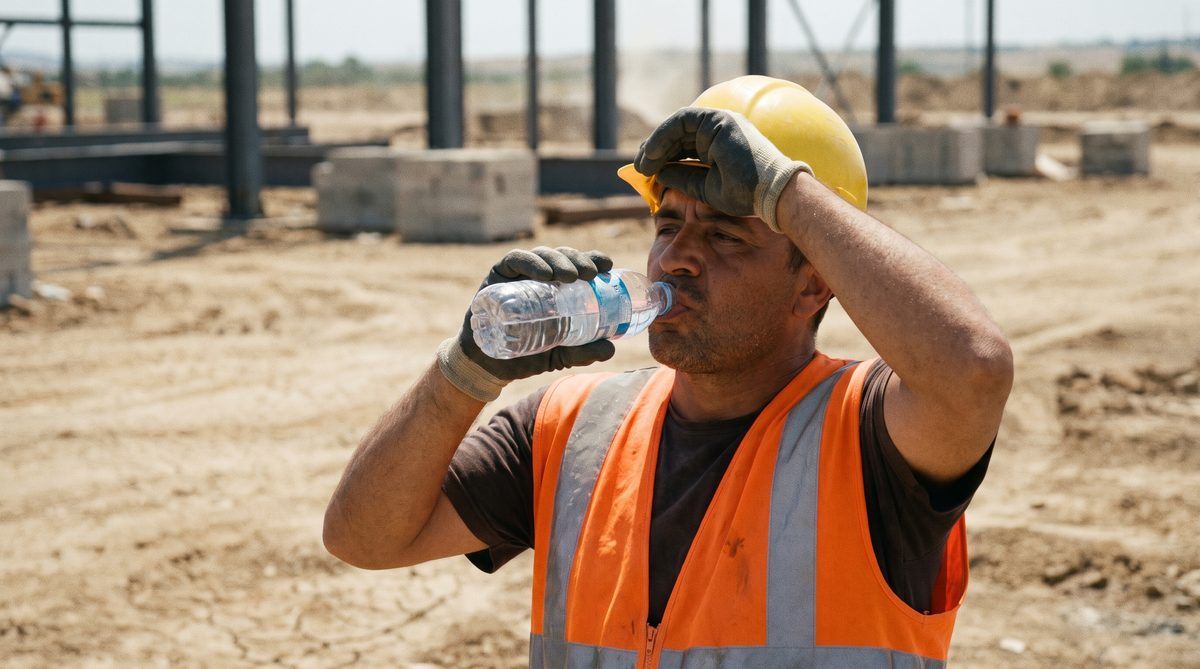
During prolonged hot weather, employers in Hungary must take mandatory measures to protect workers: above an effective temperature of 24 degrees C, protective drinks must be provided at least every half hour, hourly rest breaks of 5-10 minutes must be scheduled, and the maximum permitted effective temperature is 27-31 degrees C depending on the type of work. These rules are set out in Joint Decree 3/2002. (II. 8.) of the Ministries of Health and of Social and Family Affairs.
For the second week running, the daily mean temperature (not the daily maximum!) has reached 27-29 degrees C virtually everywhere in the country - hard on everyone, but especially on those doing heavy physical work.
Enhanced protection against the harmful effects of extreme heat is needed above all for those doing physical work outdoors in direct sunlight (e.g. construction, road building, road paving, agricultural work), but the law protects indoor workers as well.
What does the law say?
Section 7(1) of Decree 3/2002. (II. 8.) EuM-SzCsM on the minimum requirements for workplaces clearly states that the temperature of rooms accommodating work areas must remain suitable for the human body throughout the entire working time, taking into account the nature of the work and the physical strain on the workers concerned.
Decree 3/2002. (II. 8.) EuM-SzCsM
What is the highest acceptable temperature?
Annex 2 of the decree covers this in detail. Depending on the nature of the work, the maximum permitted effective temperature values are as follows (a calculated index that takes into account air temperature, relative humidity and air velocity alike):
- Mental (office) work: 31 degrees C
- Light physical work: 31 degrees C
- Moderately heavy physical work: 29 degrees C
- Heavy physical work: 27 degrees C
Protective drinks above 24 degrees C
Where the workplace climate exceeds the health limit of 24 degrees C, whether indoors or outdoors, workers must be provided with a protective drink on request, but at least every half hour. Fluid loss should generally be replaced with drinking water at 14-16 degrees C. A flavoured, non-alcoholic drink of the same temperature is also acceptable, with a sugar content of no more than 4% or sweetened artificially. Individual drinking cups must be provided for personal use, in sufficient quantity to be available to everyone.
Key pointAbove an effective temperature of 24 degrees C, protective drinks are not optional - they are an employer obligation: a non-alcoholic drink at 14-16 degrees C must be offered at least every half hour.
Rest breaks
At indoor workplaces where a suitable climate cannot be ensured by mechanical ventilation or air conditioning, work must be organised so that rest breaks of at least 5 but no more than 10 minutes per hour are scheduled (even longer during heat alert periods). Workers should spend these breaks in a rest area cooler than the work environment, ideally within the comfort zone and equipped with suitable seating.
What should employers pay attention to?
- Ventilation systems and air-conditioning units must be maintained regularly, following the manufacturer's instructions.
- During the critical heat alert period (between 11 a.m. and 3 p.m.), extra caution is required for hazardous work and work at height: the rules on lone working should be adjusted where possible, and age-related factors, the body's capacity to adapt and current individual tolerance must be kept in mind.
- In a hot workplace climate, personal protective equipment (especially respiratory protection) can place an additional, individually varying strain on the wearer, so it is advisable to seek the opinion of the occupational health physician. Where PPE is required, the rules of work may also need to be modified.
- Windows, skylights and glass walls should be of a type that eliminates the effects of strong solar radiation, as appropriate to the work and the workplace.
WarningWorkers must be instructed to stop work immediately if symptoms occur (e.g. headache, dizziness, blurred vision, thirst, rapid heartbeat), go to the rest area, and request first aid or medical care if needed.
Further details can be found in Section 7 and Annex 2 of Decree 3/2002. (II. 8.) EuM-SzCsM.