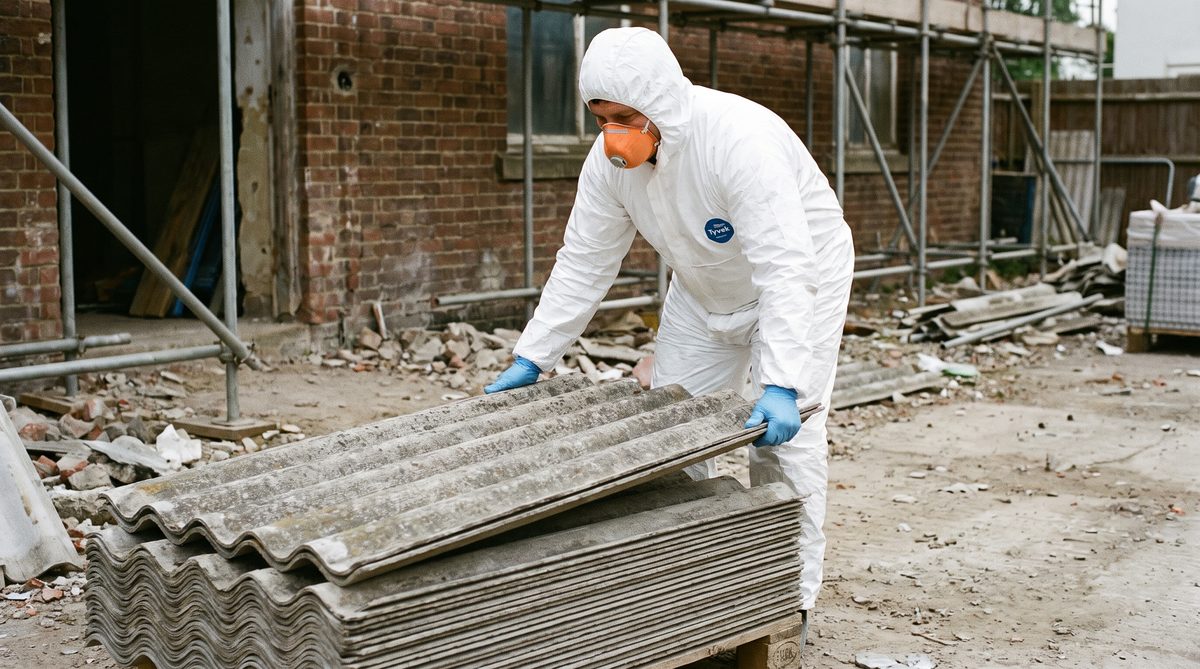
Even though the use of asbestos is banned, it is still present in older buildings, and it can become airborne during demolition, renovation or even a simple home drilling job - and the inhaled fibres cause diseases that are mostly fatal after a long latency period. In Hungary, a risk assessment and prior written notification to the labour safety inspectorate are mandatory before any work involving asbestos exposure.
The United Kingdom's health and safety authority has launched a campaign to reduce asbestos-related diseases. According to their statistics, even though the use of asbestos has been banned in the UK since 1999 (in Hungary, all activity involving asbestos-containing materials has been banned since 2005), on average 20 people still lose their lives every week to diseases caused by this killer material.
Although asbestos has been completely phased out of construction materials, this does not mean it is absent from buildings constructed earlier. It becomes a problem especially when the material's structure is damaged during demolition or renovation work and the workers inhale the tiny asbestos particles released into the air.
WarningAsbestos fibres can be released into the air even by a simple home drilling job, if the wall contains asbestos-bearing material!
What is asbestos, and why is it so dangerous?
Asbestos is the collective name for a group of naturally occurring magnesium silicate minerals with a distinctive fibrous structure, built up of needle-like crystals. Its two most common types are white asbestos (chrysotile) and blue asbestos (crocidolite). Used since antiquity and eventually spread worldwide, asbestos owed its popularity - mainly in construction - to its excellent heat and fire resistance, resistance to acids and electrical insulating properties.
The danger of asbestos stems from its structure: the extremely thin elementary fibres are less than a thousandth of a millimetre in diameter. This is precisely what makes it dangerous - the fibres can lodge in the narrower sections of the airways and even reach the alveoli of the lungs, piercing them and damaging the pleura. Asbestos-related health damage develops over a long period and is fatal in most cases. It can cause asbestosis, mesothelioma - a cancer of the pleura and the peritoneum - as well as bronchial, stomach and intestinal cancers.
What does Hungarian law require?
In Hungary, under the authorisation granted in Section 88(2) of Act XCIII of 1993 on Occupational Safety, Decree 12/2006. (III. 23.) EuM governs the protection of workers exposed to asbestos-related risks.
For any activity where a risk of asbestos exposure can be presumed, the employer must carry out a risk assessment in accordance with Section 54 of the Occupational Safety Act and must notify the labour safety inspectorate of the competent metropolitan or county government office in writing 15 days before the work begins. The notification must make it possible to establish the nature and extent of the asbestos exposure affecting the workers.
Act XCIII of 1993 Decree 12/2006. (III. 23.) EuM
Our consulting team is a committed partner to our clients in protecting against asbestos as well, doing everything possible to ensure that no such tragedy befalls your employees. Join the ranks of responsible employers!