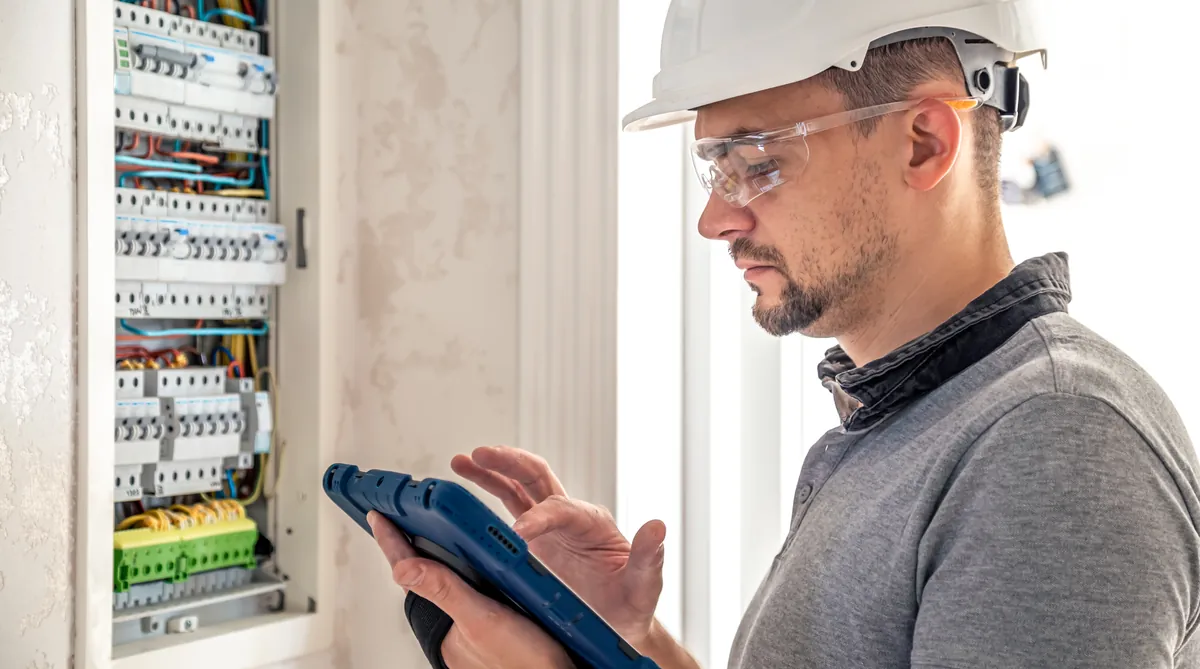
In brief: when a flat in Hungary is sold (change of ownership) or let, an electrical safety inspection must be carried out unless a qualification document is available certifying an earlier inspection no more than 6 years old at the time of the transaction.
Many people only hear about this obligation a few days before signing the sale contract, when the lawyer or the buyer asks about it. The inspection can help uncover electrical faults that increase the risk of electric shock or fire, and the documented results can also matter in later legal disputes. Below we summarise what you need to know in plain language: when it is required, what it means and what to watch out for.
What is an electrical safety inspection?
An electrical safety inspection is a professional, instrument-based check of a flat's electrical installation. During the inspection the specialist assesses the safety condition of the installation against the applicable technical requirements, and documents the measurement results and any shortcomings found.
The inspection covers the safety-relevant parts of the flat's electrical network, including among others:
- the distribution board (fuse box), the miniature circuit breakers and the residual current device (RCD),
- the wiring running in the walls,
- sockets, switches and light fittings,
- the connections of permanently wired appliances (e.g. water heater, electric cooker).
The electrical safety inspection is regulated by Decree 40/2017. (XII. 4.) NGM. Carrying out the inspection and issuing the qualification document requires a specialist with the prescribed qualification.
When is it mandatory?
Under Decree 40/2017. (XII. 4.) NGM, the electrical installation of flats in residential buildings must undergo an electrical safety inspection on a change of ownership and on letting if no qualification document is available certifying an inspection no more than 6 years old at the time of the transaction.
Importantcarrying out the electrical safety inspection and obtaining a satisfactory rating are two separate questions. An unsatisfactory rating does not in itself mean that the property cannot be sold or let. The faults found, however, must be dealt with in line with the applicable regulations and the qualification document; in the case of a dangerous fault the necessary measures must be taken without delay.
In the following cases different inspection obligations may apply. The exact content and frequency of the required check depend on the type of installation, its use and the applicable legal requirements.
| When? | What does it mean in practice? |
|---|---|
| On installation, before first commissioning | The first check of a new electrical installation must be carried out as an electrical safety inspection |
| After alteration or repair | The affected part of the installation must be checked in line with the applicable regulations before it is put back into service |
| After a dangerous fault or an extraordinary event | An inspection matching the nature and severity of the fault or event must be carried out |
| Periodically, at least every 6 years | For the electrical installations of residential buildings, as a general rule every six years, with the exception set out in the regulation |
| Periodically, at least every 3 years | In the cases specified in the decree, for example the electrical installations of buildings that qualify as workplaces, and certain electrical installations operating in potentially explosive environments |
Common misconception“I have an RCD, so I don’t need it.” There is indeed an exception: the periodic electrical safety inspection of a flat in a residential building that is not rented out may be omitted if the flat’s electrical installation is limited by overcurrent protection of no more than 32 A rated current per phase, and the user equipment is protected by a residual current device with a sensitivity of no more than 30 mA. This exception does not replace the separate rule that applies on a change of ownership or on letting: in those cases the inspection is still required if no suitable qualification document no more than six years old is available.
It is important to know that the obligation to have the electrical safety inspection carried out exists regardless of whether the contract is concluded. It is therefore worth clarifying whether the documentation exists already when preparing the sale or tenancy contract, and discussing it with the lawyer during the transaction.
Why is it worth it for the seller and the landlord?
The inspection serves the interests of the seller and the landlord, while also helping to protect the safety of the buyer and the tenant.
- Protection against warranty claims. If the buyer received the report when the contract was concluded, it can help clarify which shortcomings they were aware of. This can reduce the chance of later disputes, but does not in itself rule out warranty claims.
- Landlord liability. The landlord must ensure that the flat is fit for safe use. If a tenant suffers an electric shock, a court may also establish the landlord’s liability for damages – especially if there were warning signs (e.g. a fuse that trips frequently).
- Preventing insurance disputes. In the event of fire or property damage caused by a short circuit, the insurer may examine the condition of the network. The inspection report can help prove when the network was inspected and the circumstances found at that time.
- A smoother sale. The completed documentation records the condition of the property at the time of sale or letting, which creates a clear situation and builds the buyer’s trust.
- Hidden faults from the previous owner. Many older flats have unprofessional, “DIY” extended circuits that even the current owner does not know about. The inspection can reveal these before something goes wrong.
How does the inspection work?
- Booking and preparation. Before a sale or letting it is advisable to contact the inspector in good time and to look out the earlier qualification document. If a suitable document no more than six years old is available at the time of the transaction, a new inspection is not necessarily required for this reason.
- On-site inspection. The specialist checks the electrical installation and carries out measurements as needed. A temporary power cut may be necessary for the duration of the inspection.
- Measurements and evaluation. Among other things, the specialist checks the continuity of the protective conductors, the insulation resistance and the operation of the residual current device, according to the applicable technical requirements.
- Qualification document. The results and any shortcomings found are documented in writing.
- Dealing with faults. The shortcomings found must be dealt with in line with the applicable regulations and as set out in the qualification document. Where there is a direct danger to life or of fire, immediate action is required.
Tipif the flat has no RCD, it is worth discussing its installation with a specialist. It can provide important additional protection against electric shock, but it does not replace the inspection of the electrical network and the repair of the faults found.
Selling or letting your property? We can help!
Our qualified electrical safety inspectors carry out the inspection quickly and at a flexible time, and prepare the qualification document recording the result of the inspection, which can be used in the sale or letting transaction. If we find a shortcoming, we explain clearly what needs to be done.
This article is for information only and does not constitute legal advice.
Legal background: Decree 40/2017. (XII. 4.) NGM on service connection and consumer installations and on electrical equipment and protective systems operating in potentially explosive atmospheres, according to the text in force when the article was written.
Sources used for this article
- ingatlan.com Knowledge Base – When is an electrical inspection mandatory in 2026? (in Hungarian)
- e-ingatlanugyvedek.hu – Electrical safety inspection in a property sale (in Hungarian)
- Bank360.hu – Electrical safety inspection is mandatory when selling or letting a flat (in Hungarian)
- Decree 40/2017. (XII. 4.) NGM – National Legislation Database (in Hungarian)